Architecture
Decentralized off-chain payment channels between autonomous AI agents over libp2p + Ethereum/Algorand/Filecoin.
1. System Overview
This system implements off-chain payment channels between autonomous AI agents communicating over libp2p. The design follows the same pattern used by Filecoin payment channels and Ethereum state channels: lock funds on-chain once, exchange signed vouchers off-chain many times, settle on-chain once.
The core insight is that agent-to-agent micropayments need sub-second latency and near-zero marginal cost per transaction. On-chain transactions are too slow and expensive for per-request payments. Payment channels solve this by moving the payment loop off-chain while preserving the security guarantees of the underlying blockchain.
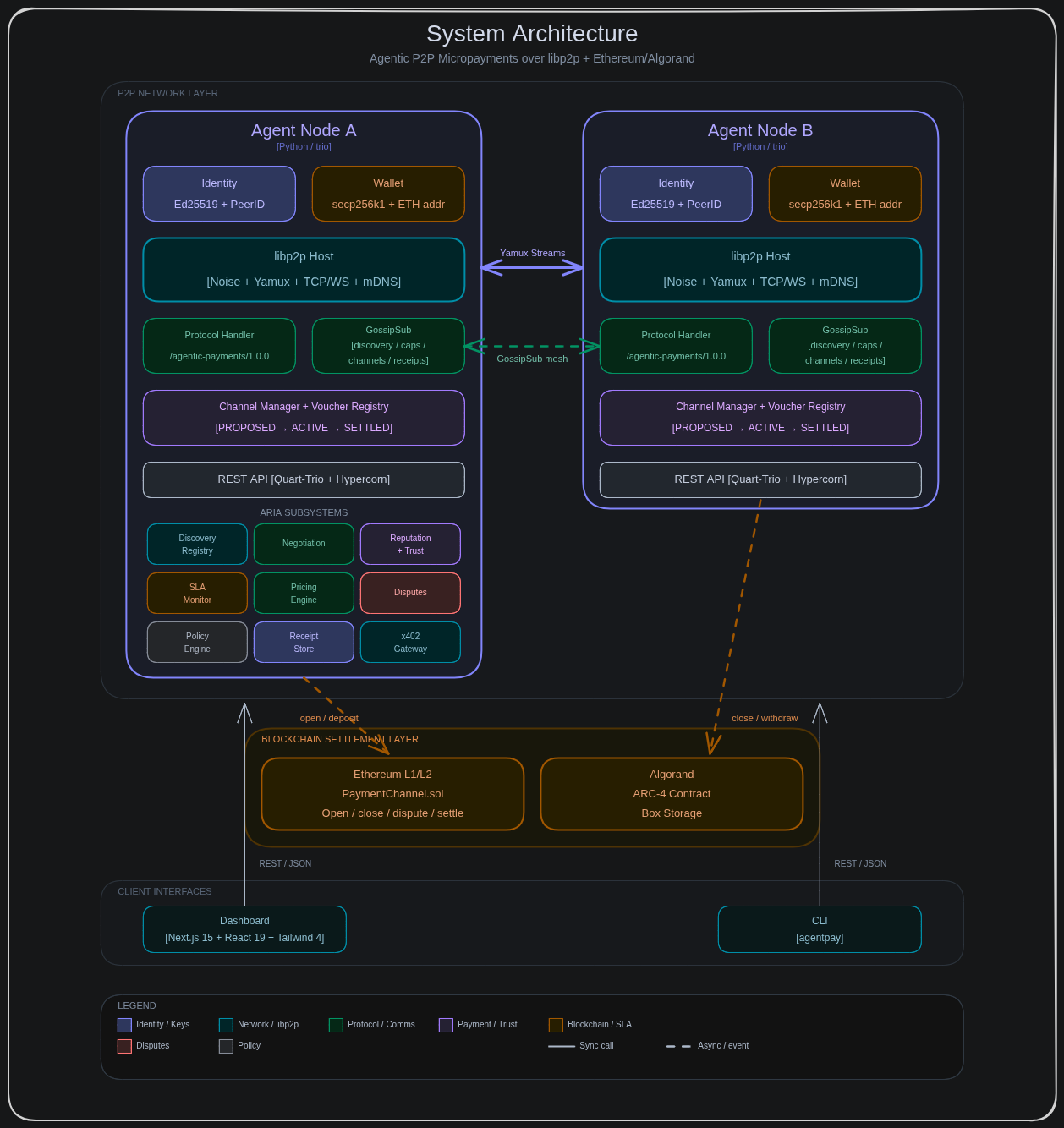 System Architecture — Agent nodes, libp2p networking, and Ethereum settlement
2. Networking Layer
2.1 Host Configuration
The libp2p host is created via libp2p.new_host() with:
- Key pair: Ed25519 (generated or loaded from disk)
- Muxer: Yamux (preferred over mplex for better flow control)
- Security: Noise protocol (authenticated encryption, no TLS certificates needed)
- Discovery: mDNS via
enable_mDNS=True(zeroconf broadcast on LAN) - Transports: TCP (default), WebSocket (optional, for browser clients)
# agent_node.py — host creation
self.host = new_host(
    key_pair=key_pair,
    muxer_preference="YAMUX",
    enable_mDNS=self.config.node.enable_mdns,
)
The host listens on configurable TCP and WebSocket ports. Multiaddrs are advertised with the /p2p/<peer_id> suffix for direct dialing.
2.2 Stream Protocol
The custom payment protocol is registered as /agentic-payments/1.0.0 on the libp2p host. When a remote peer opens a stream, multistream-select negotiates the protocol, then the PaymentProtocolHandler takes over.
Streams are bidirectional byte pipes multiplexed over Yamux. Multiple concurrent streams can exist between the same two peers without opening additional TCP connections.
2.3 Peer Discovery
Discovery has three sources, merged into a unified view:
- mDNS — Automatic LAN discovery. The host’s
enable_mDNS=Trueflag uses zeroconf to broadcast and listen. - Connected peers — The host tracks all active connections.
host.get_connected_peers()returns live peer IDs. - Manual connections — CLI
peer connect <multiaddr>adds peers directly viahost.connect().
2.4 GossipSub Pubsub
Four topics for coordination:
| Topic | Purpose |
|---|---|
/agentic/discovery/1.0.0 |
Agent announcements (peer_id, eth_address, listen addrs) |
/agentic/capabilities/1.0.0 |
Service advertisements and pricing |
/agentic/channels/1.0.0 |
Channel announcements for network routing topology |
/agentic/receipts/1.0.0 |
Payment receipts for transparency/auditing |
GossipSub is configured with degree=8, degree_low=6, degree_high=12, heartbeat_interval=120s, and strict_signing=True.
3. Wire Protocol
3.1 Framing
Every message on a payment protocol stream uses length-prefix framing:
┌──────────────────┬──────────────────────────┐
│  4 bytes         │  N bytes                 │
│  big-endian uint │  msgpack payload         │
│  (payload length)│                          │
└──────────────────┴──────────────────────────┘
Maximum message size: 1 MB.
3.2 Message Types
| Type | ID | Fields |
|---|---|---|
PAYMENT_OPEN |
1 | channel_id, sender, receiver, total_deposit, nonce, timestamp, signature |
PAYMENT_UPDATE |
2 | channel_id, nonce, amount (cumulative), timestamp, signature |
PAYMENT_CLOSE |
3 | channel_id, final_nonce, final_amount, cooperative, timestamp, signature |
PAYMENT_ACK |
4 | channel_id, nonce, status, reason |
HTLC_PROPOSE |
5 | channel_id, payment_hash, amount, timeout, hop_count |
HTLC_FULFILL |
6 | channel_id, payment_hash, preimage |
HTLC_CANCEL |
7 | channel_id, payment_hash, reason |
CHANNEL_ANNOUNCE |
8 | channel_id, peer_a, peer_b, capacity |
NEGOTIATE_PROPOSE |
9 | negotiation_id, service_type, proposed_price, channel_deposit, timeout |
NEGOTIATE_COUNTER |
10 | negotiation_id, counter_price |
NEGOTIATE_ACCEPT |
11 | negotiation_id |
NEGOTIATE_REJECT |
12 | negotiation_id, reason |
ERROR |
15 | code, message |
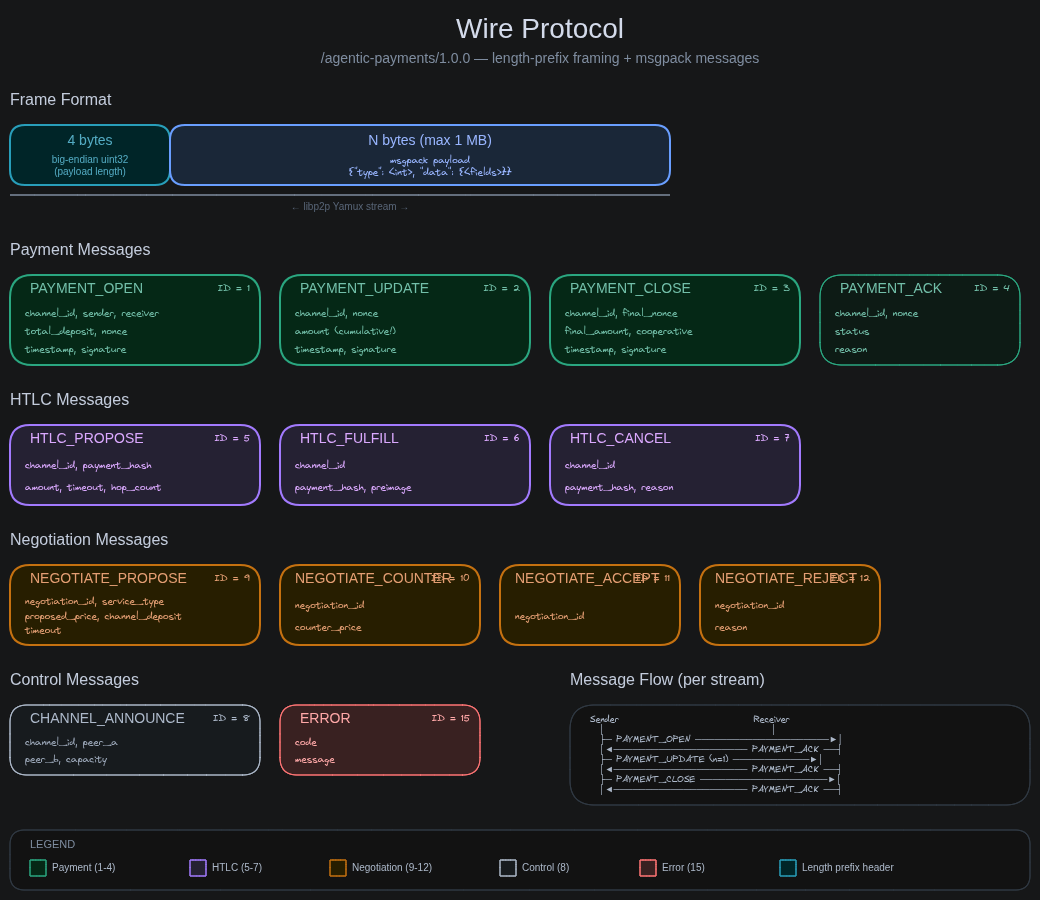
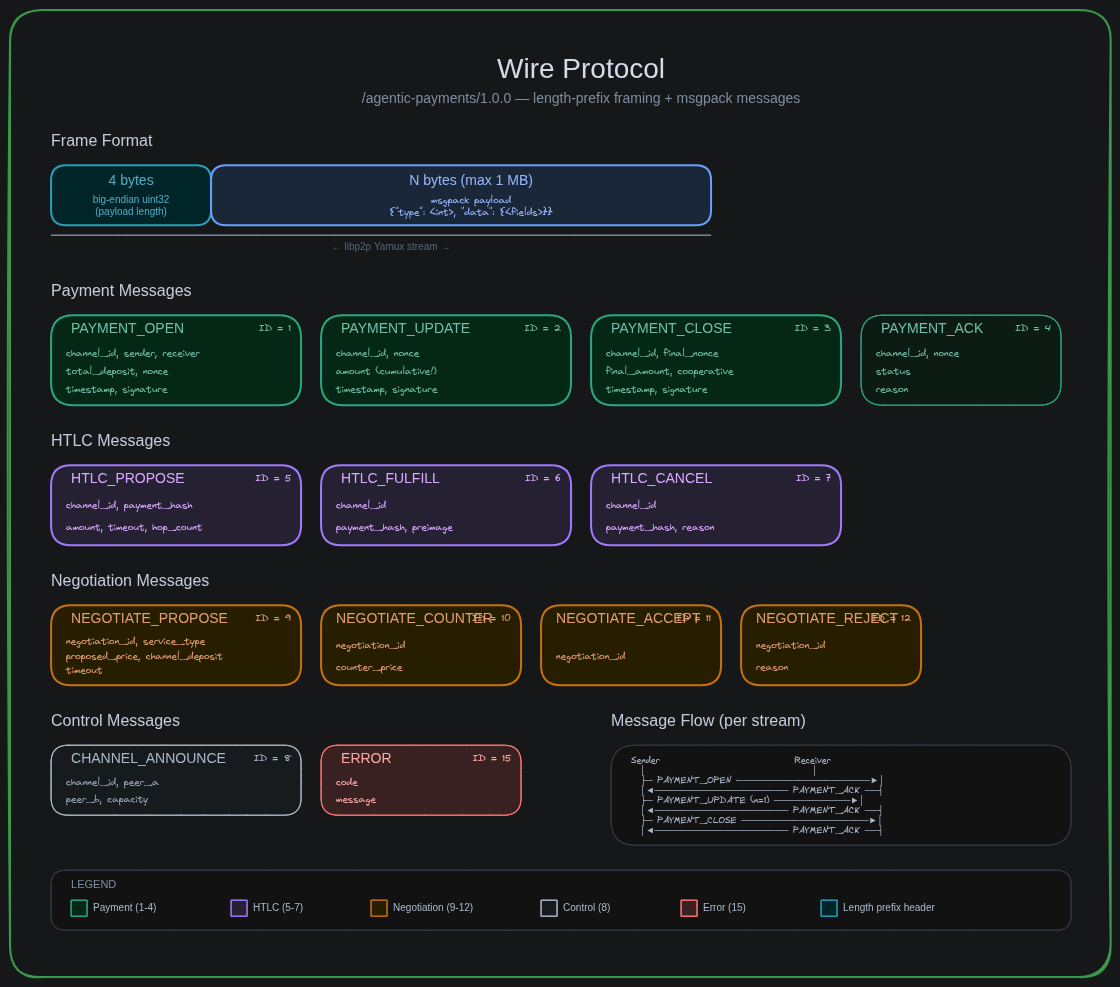 All 13 message types with fields and framing format
4. Payment Channel Design
4.1 Channel State Machine
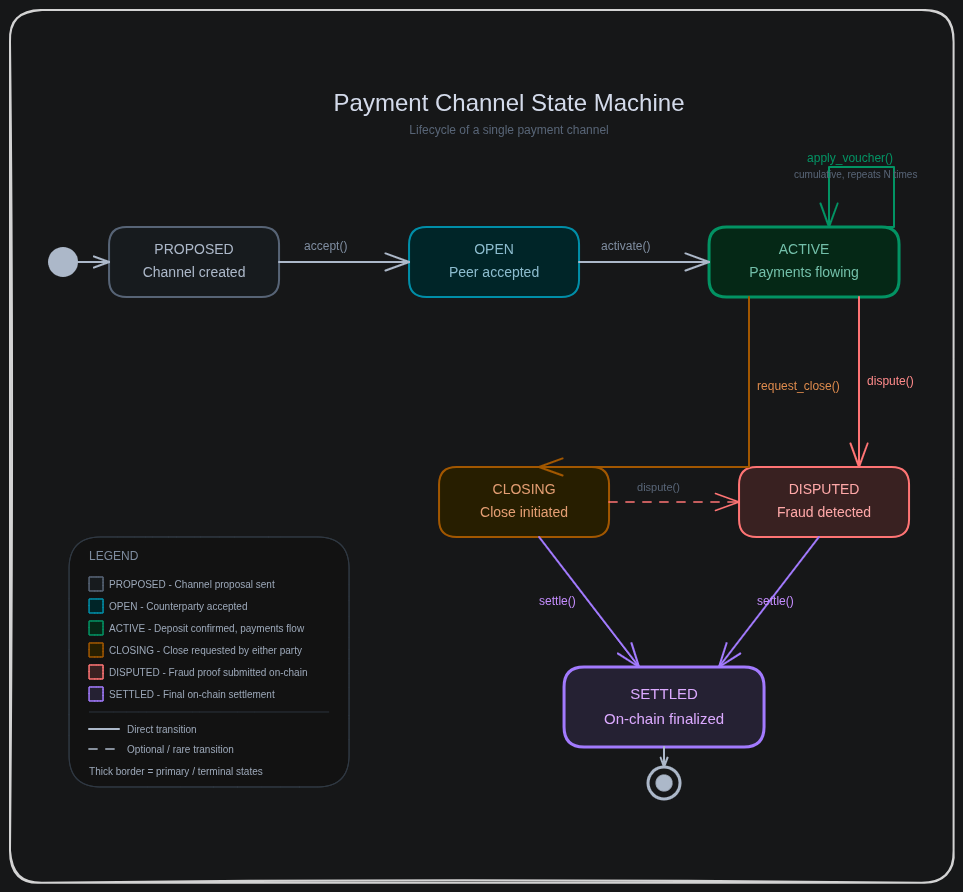 Payment Channel State Machine — lifecycle of a single payment channel
Transitions:
| From | To | Trigger | Description |
|---|---|---|---|
PROPOSED |
OPEN |
accept() |
Counterparty accepts the channel open proposal |
OPEN |
ACTIVE |
activate() |
On-chain deposit confirmed |
ACTIVE |
ACTIVE |
apply_voucher() |
Micropayment voucher exchange loop |
ACTIVE |
CLOSING |
request_close() |
Either party initiates close |
ACTIVE/CLOSING |
DISPUTED |
dispute() |
Fraud detected or disagreement |
CLOSING/DISPUTED |
SETTLED |
settle() |
On-chain settlement confirmed |
4.2 Voucher Design (Filecoin-style)
Vouchers use cumulative amounts, not incremental. Each new voucher replaces the previous one.
Voucher n=1: amount=100    (paid 100 total)
Voucher n=2: amount=250    (paid 250 total, not 150 more)
Voucher n=3: amount=400    (paid 400 total)
                            ▲
                            └── Only this one needed for settlement
Signature scheme:
hash = keccak256(abi.encodePacked(channel_id, nonce, amount, timestamp))
signature = EIP-191 personal_sign(hash, sender_private_key)
4.3 Voucher Validation Rules
- Channel must be in
ACTIVEstate voucher.nonce > channel.nonce(strictly increasing)voucher.amount > channel.total_paid(strictly increasing cumulative amount)voucher.amount <= channel.total_deposit(cannot exceed locked funds)- Signature must recover to the channel sender’s Ethereum address
5. On-Chain Settlement
Smart Contract
The PaymentChannel.sol contract implements unidirectional payment channels with a challenge period:
| Function | Who calls | What it does |
|---|---|---|
openChannel() |
Sender | Deposits ETH, creates channel struct |
closeChannel() |
Receiver | Verifies ECDSA signature, starts challenge period |
challengeClose() |
Anyone | Submits higher-nonce voucher, resets challenge timer |
withdraw() |
Either | After challenge expiry: receiver gets amount, sender gets refund |
Signature Compatibility
The voucher hash is computed identically off-chain and on-chain:
// Solidity
keccak256(abi.encodePacked(channelId, nonce, amount, timestamp))
# Python
Web3.solidity_keccak(
    ["bytes32", "uint256", "uint256", "uint256"],
    [channel_id, nonce, amount, timestamp],
)
6. Payment Flow (End-to-End)
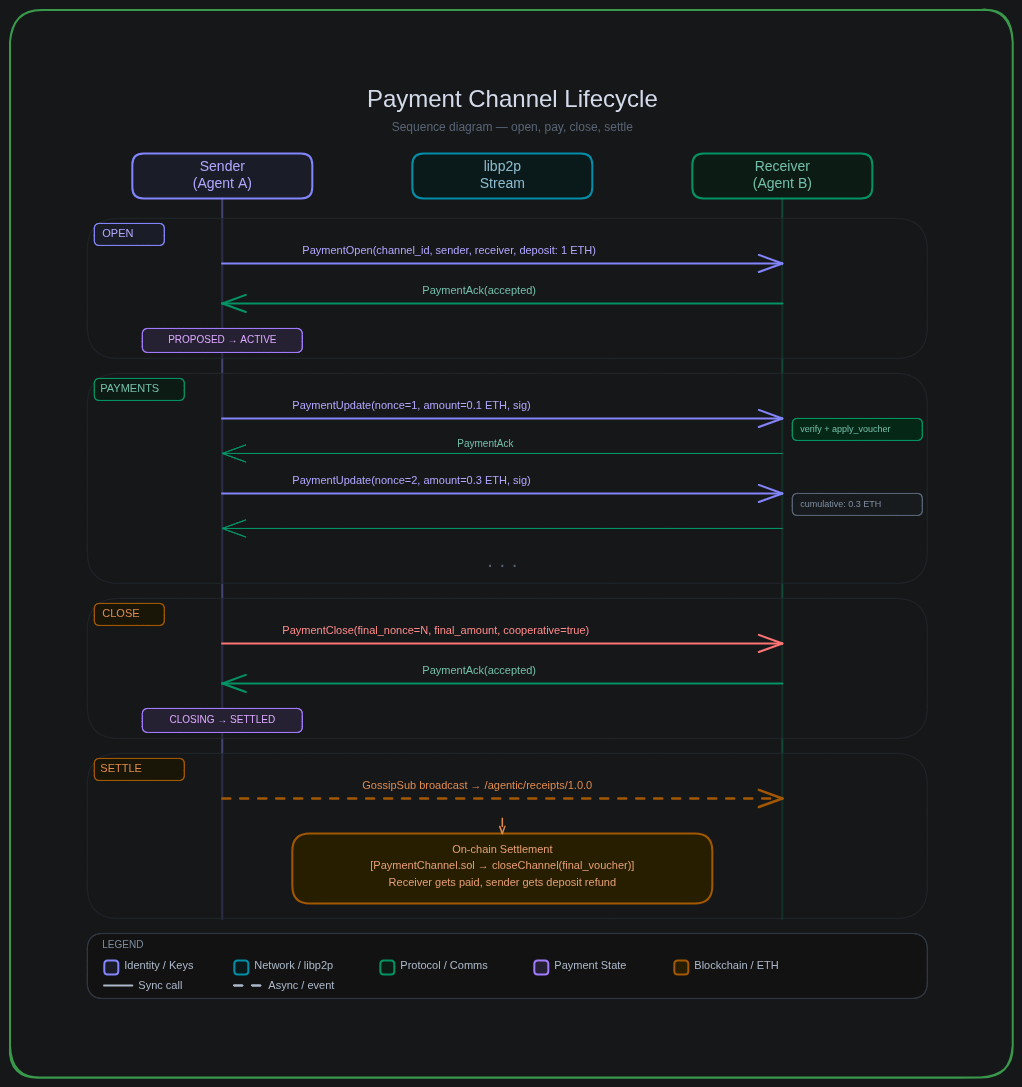 Payment Channel Lifecycle — open, pay, close, settle
7. API Layer
The REST API runs on Quart-Trio served by Hypercorn with ~50 endpoints across 10 groups. See CLI & API Reference for the full endpoint list.
8. Identity and Cryptography
| Key System | Curve | Purpose | Storage |
|---|---|---|---|
| libp2p Identity | Ed25519 | Peer identification, Noise handshake | ~/.agentic-payments/identity.key |
| Ethereum Wallet | secp256k1 | Voucher signing (ECDSA), on-chain transactions | Generated fresh per session |
9. Multi-Hop Routing (HTLC)
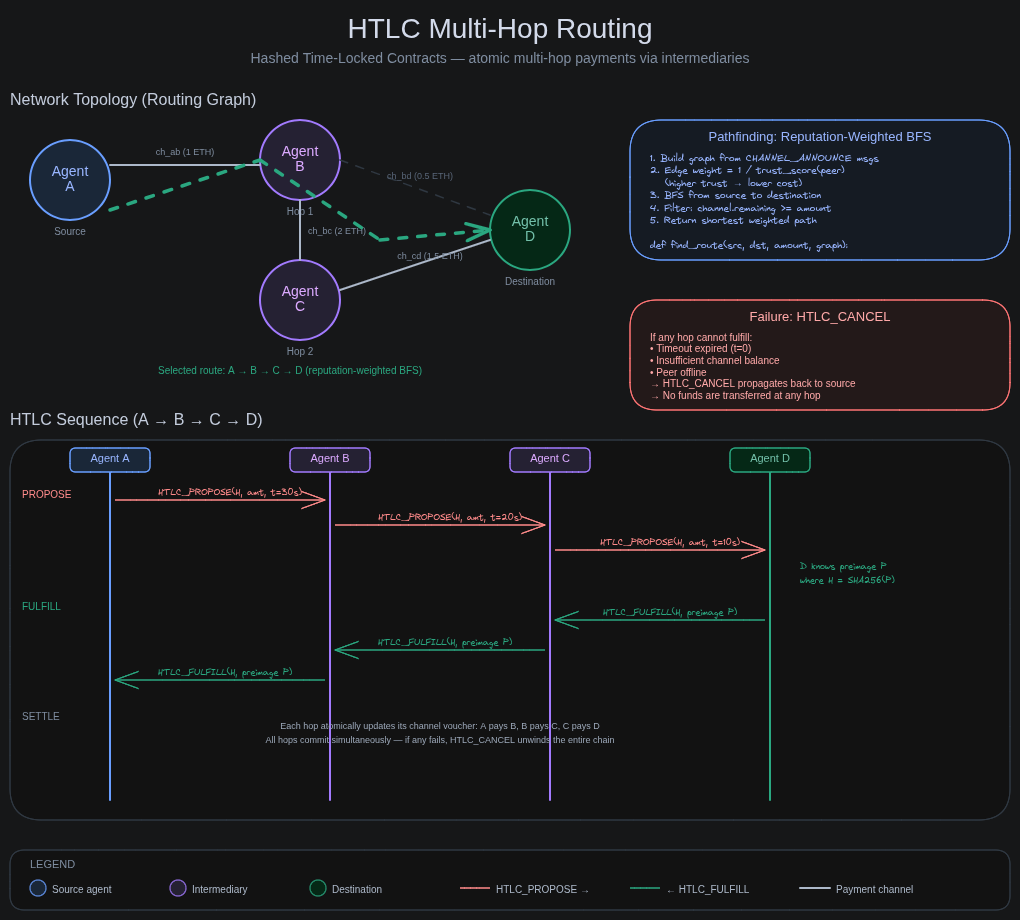 Multi-hop payment via intermediaries with reputation-weighted BFS pathfinding
The pathfinder uses reputation-weighted Dijkstra. Each hop’s HTLC timeout decrements by 120 seconds, ensuring the sender’s lock expires last.
10. Trust Architecture
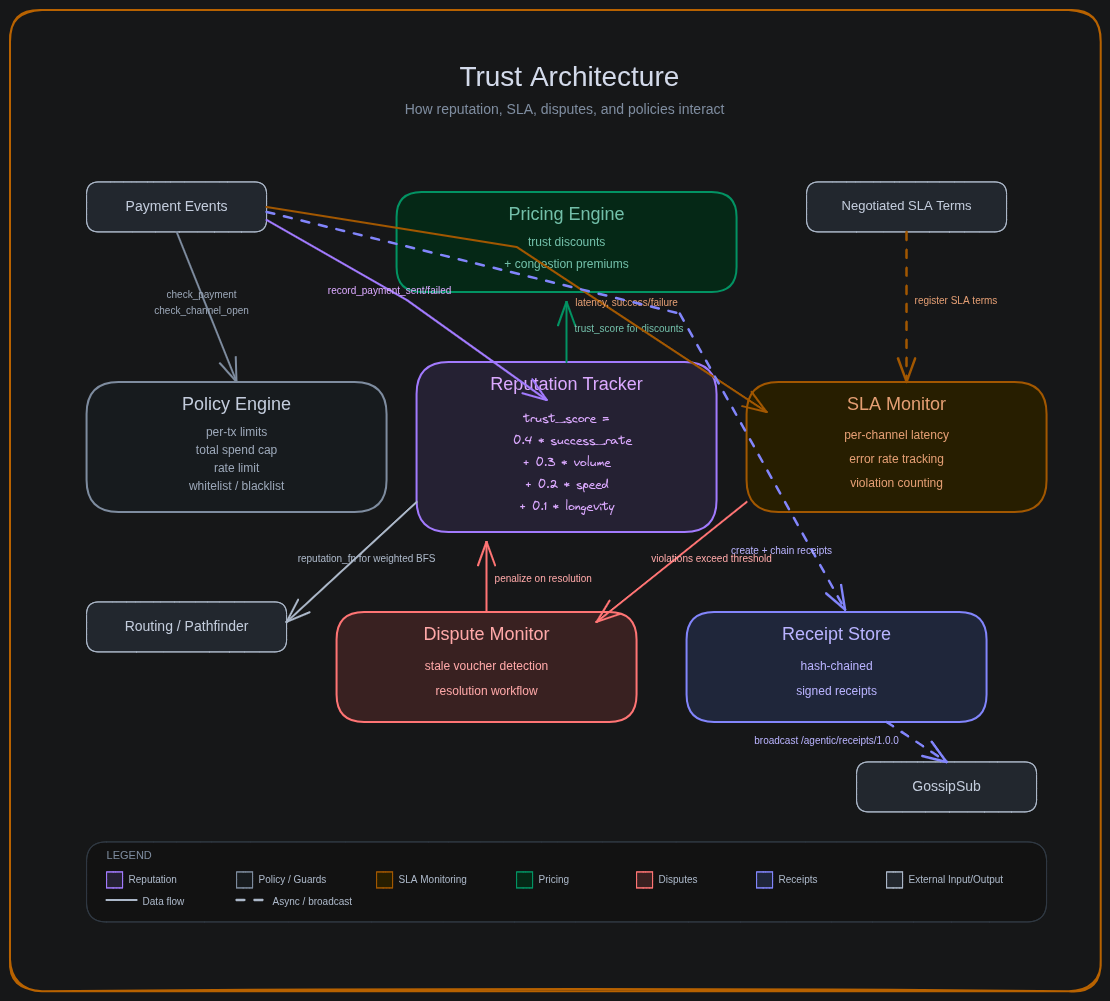 Reputation, SLA monitoring, disputes, policies, and pricing interactions
Reputation Scoring
trust_score = 0.4 * success_rate + 0.3 * normalized_volume + 0.2 * response_speed + 0.1 * longevity
Dynamic Pricing
final_price = base_price * (1 - trust_discount) * (1 + congestion_premium)
Receipt Chains
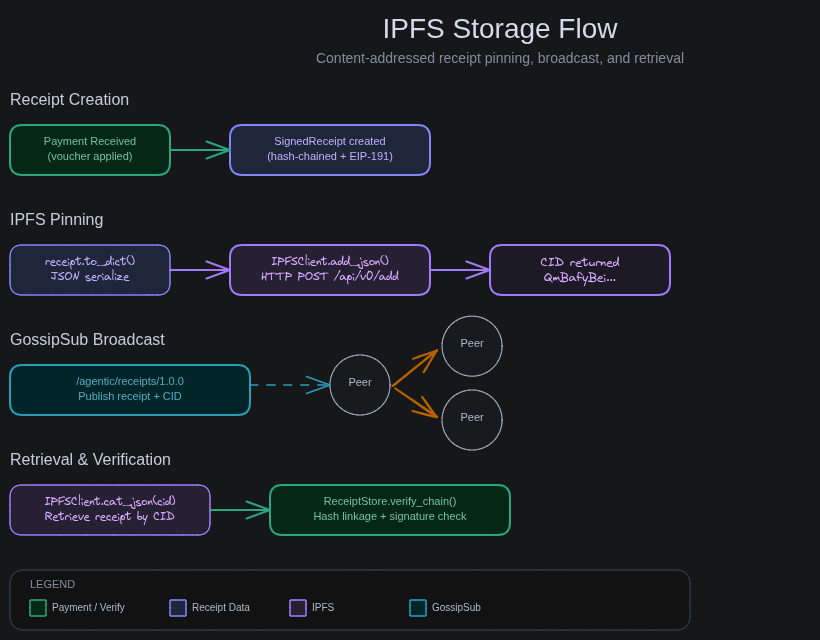
Every payment produces a SignedReceipt forming a hash chain per channel, broadcast via GossipSub for network-wide verification.
11. ERC-8004 Agent Identity
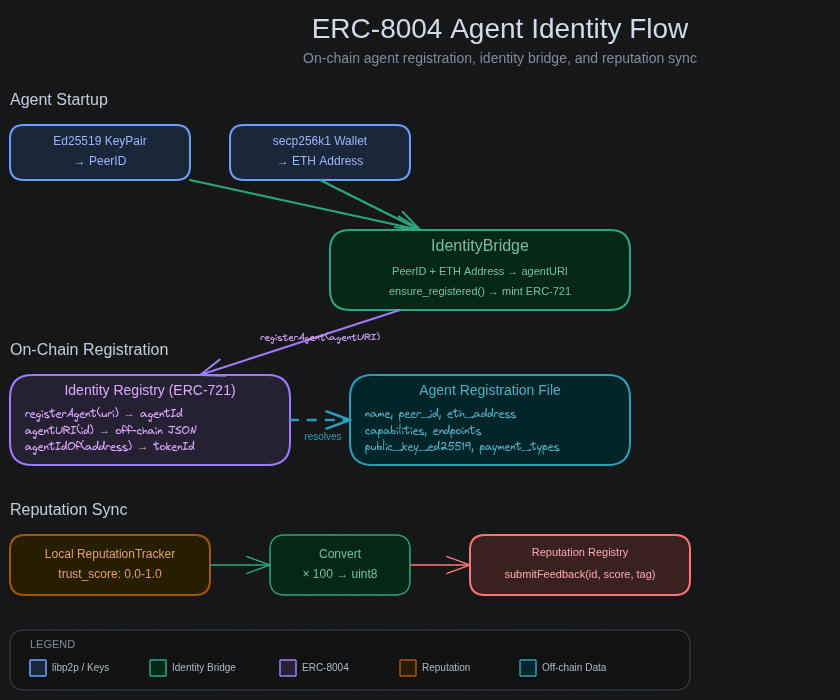 Agent registration, identity bridge, reputation sync
The IdentityBridge maps the node’s libp2p PeerID + ETH wallet to an ERC-8004 agentId (ERC-721 token), enabling cross-chain identity portability and on-chain reputation tracking.
12. Multi-Chain Settlement
| Chain | Contract | Status |
|---|---|---|
| Ethereum | PaymentChannel.sol (Solidity ^0.8) |
Implemented |
| Algorand | ARC-4 application + box storage | Implemented |
| Filecoin | Same PaymentChannel.sol on FEVM |
Implemented |
The settlement layer is chain-agnostic by design. Each chain implements SettlementProtocol independently.
13. Diagrams
| Diagram | Description |
|---|---|
| System Architecture | Full system with all subsystems |
| Payment Channel Lifecycle | 8-step sequence: open, payments, close, settle |
| Channel State Machine | 6-state lifecycle |
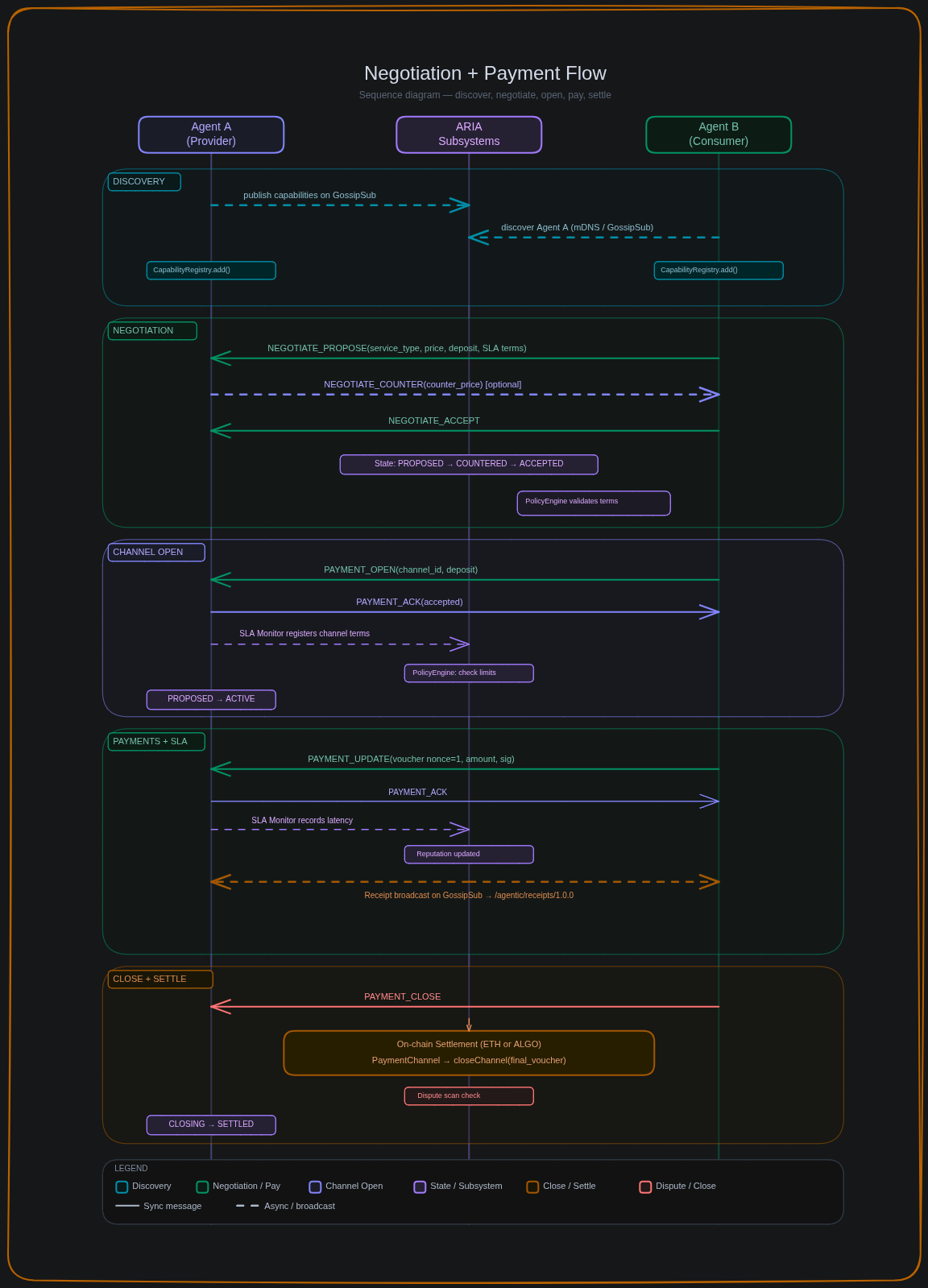
| Negotiation Flow | Discovery → negotiate → open → pay → close |
| Trust Architecture | Reputation, SLA, disputes, policies |
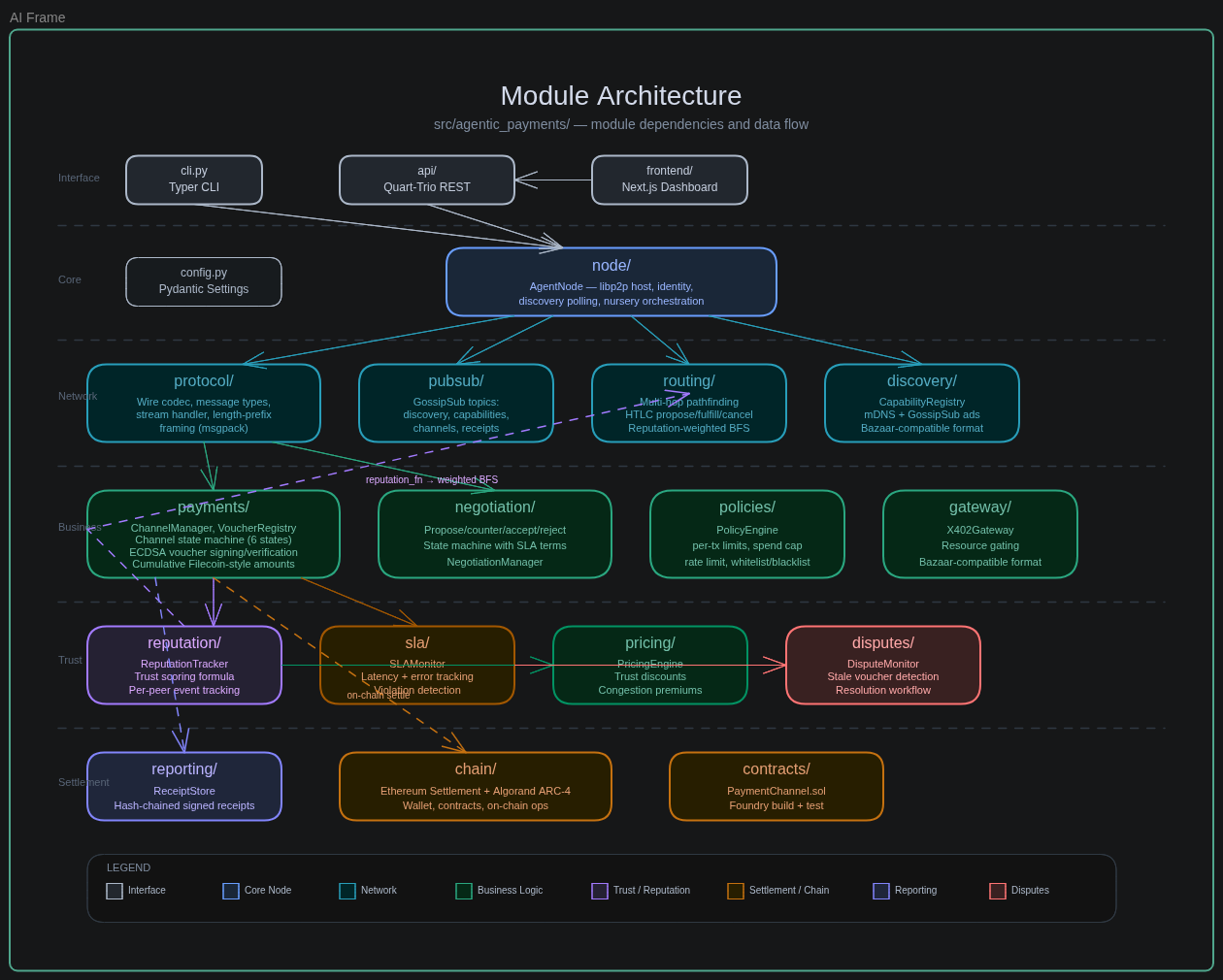
| Module Architecture | Code module dependencies |
| Wire Protocol | All 13 message types |
| HTLC Routing | Multi-hop payment via intermediaries |
| ERC-8004 Identity | Agent registration and reputation sync |
| IPFS Storage | Receipt pinning and retrieval |
| E2E Code Flow | CLI → node → libp2p → payment → settlement |