A technical deep-dive into AgentPay — from problem statement to architecture decisions, real code, and a working demo. 680 tests, 55 modules, 3 settlement chains, zero middlemen.
Reading time: ~17 minutes
TL;DR
AgentPay is a decentralized micropayment protocol built on libp2p that lets AI agents discover each other, negotiate service terms, exchange off-chain payments in sub-millisecond, and settle on Ethereum, Algorand, or Filecoin. It uses Filecoin-style cumulative vouchers, HTLC multi-hop routing, a 4-factor trust scoring system, and an autonomous agent runtime. Two on-chain transactions settle thousands of micropayments. The code is open source.
The Scenario That Started Everything
Imagine this: Agent A is a coordinator managing a research pipeline. It needs to farm out 500 document summarization tasks to the cheapest available GPU inference providers on the network. Agent B offers inference at 0.001 ETH per request with a 200ms latency SLA. Agent C offers the same service at 0.0008 ETH but has a patchy track record.
Agent A needs to answer three questions before spending a single wei:
- Who can I pay? (Discovery)
- Can I trust them? (Reputation)
- How do I pay 500 times without going bankrupt on gas? (Payment channels)
We built AgentPay because autonomous agents need an economic layer that matches their nature — peer-to-peer, instant, trustless, and fully automated.
Why Existing Solutions Fail
The Per-Transaction Trap
| Metric | Value |
|---|---|
| Tasks | 500 |
| Gas per tx | ~65,000 |
| Gas price (20 gwei) | 0.0013 ETH per tx |
| Total gas cost | 0.65 ETH (~$1,600) |
| Total wait time | 2+ hours |
The Centralized API Trap
Stripe, PayPal fail for agents: no KYC possible, 200-500ms latency, rate limits, single point of failure.
The x402 Gap
The x402 protocol is elegant for one-shot requests, but doesn’t solve persistent relationships. AgentPay bridges this gap with both x402 one-shot payments and persistent channels.
Architecture: Six Layers, One Protocol
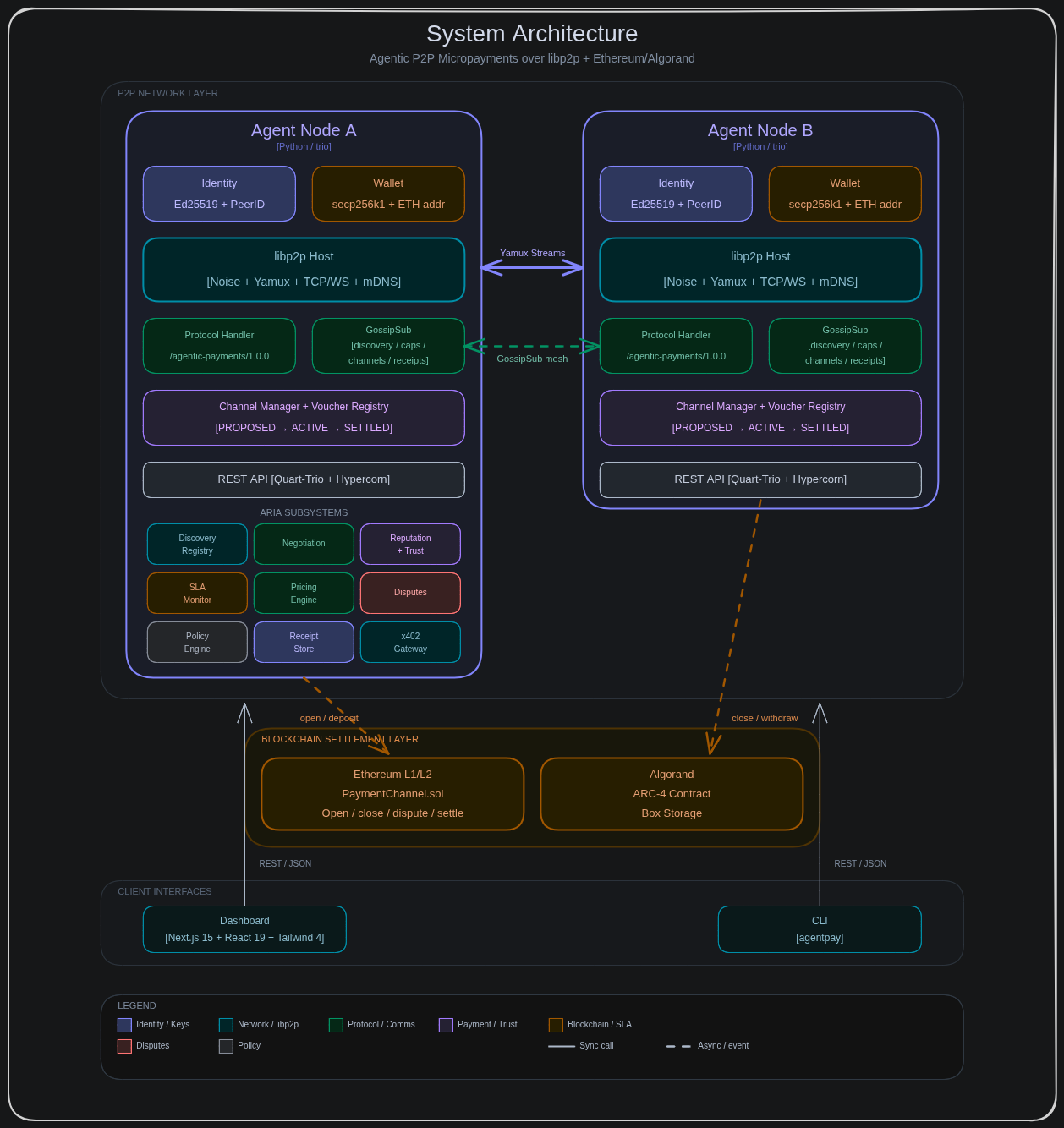 System architecture — networking, wire protocol, payment channels, settlement, identity, and trust.
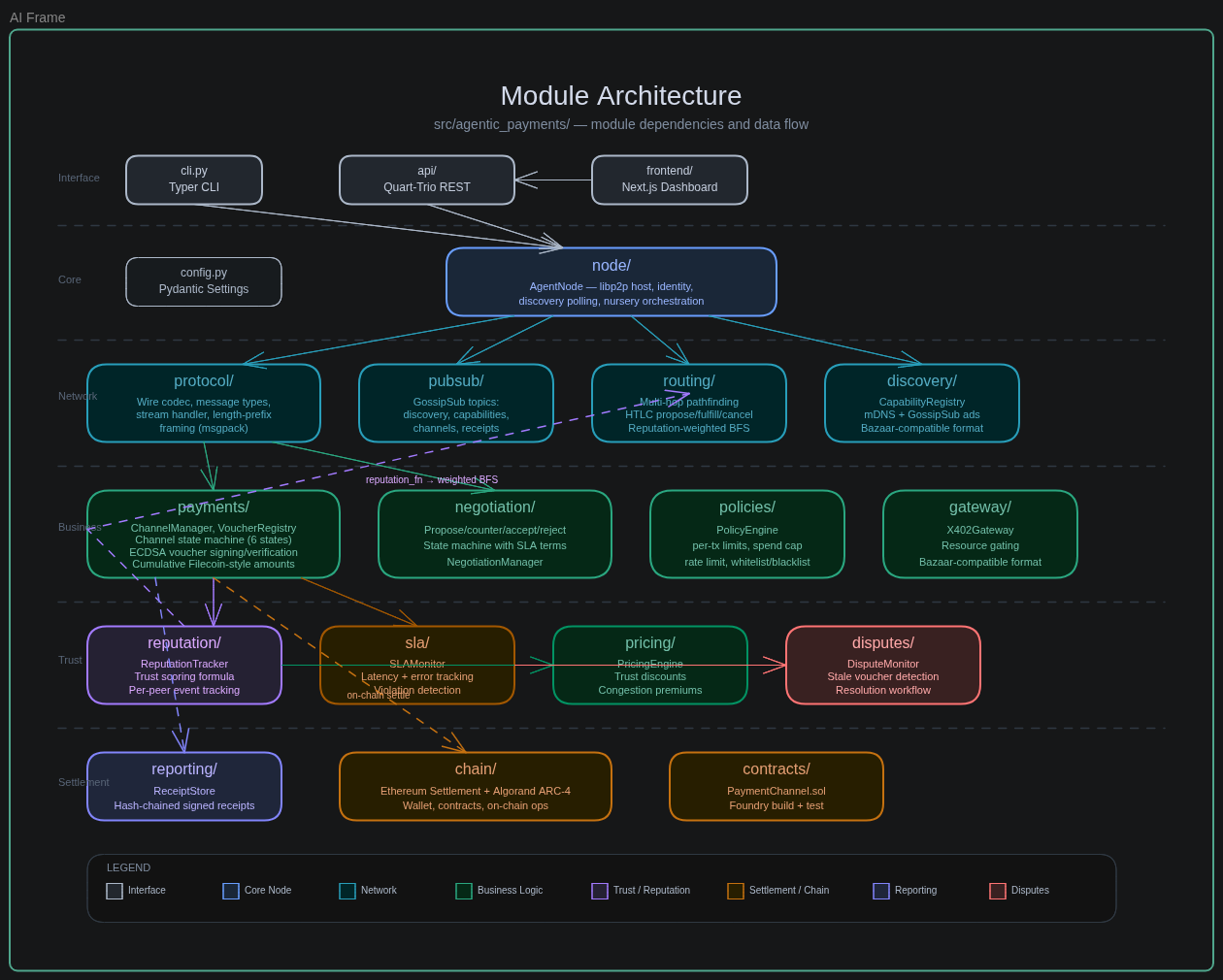 55 source modules across 19 packages. Dependencies only point downward.
Layer 1: Networking — Why libp2p, Not HTTP
With HTTP, someone has to host an endpoint. Agents are ephemeral. libp2p gives us TCP + WebSocket transports, Noise encryption, Yamux multiplexing, mDNS discovery, and GossipSub pubsub.
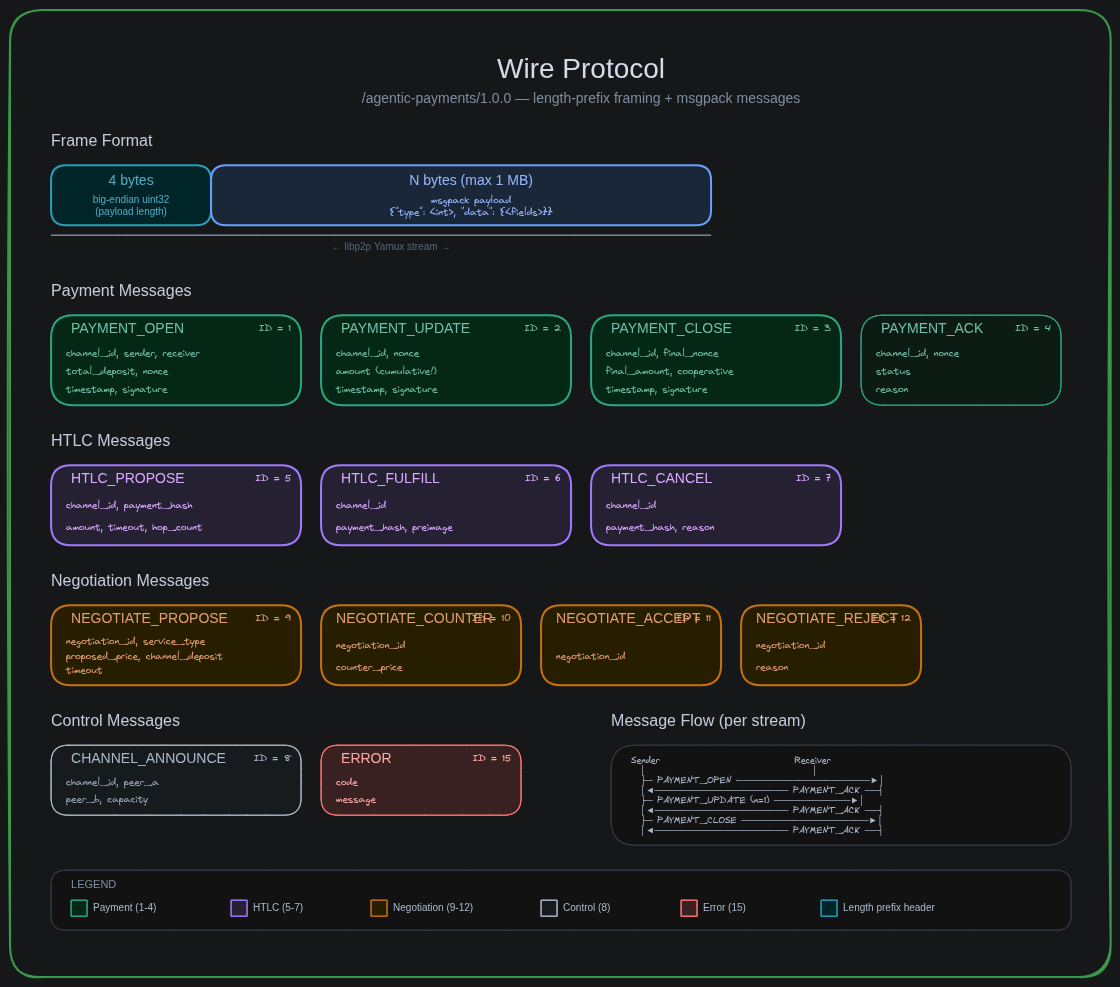 13 message types cover the complete payment lifecycle.
Layer 2: Payment Channels — Filecoin’s Voucher Model
We chose Filecoin’s cumulative voucher model over Lightning’s commitment transaction model:
| Cumulative (Filecoin/AgentPay) | Commitment (Lightning) | |
|---|---|---|
| Each payment | New voucher replaces previous | New commitment tx invalidates previous |
| State to store | 1 voucher (the latest) | All prior commitments |
| Complexity | Lower | Higher (penalty txs, watchtowers) |
The most interesting design decision: we send the voucher to the peer first, then commit locally only on success. This prevents state divergence.
Layer 3: The Channel State Machine
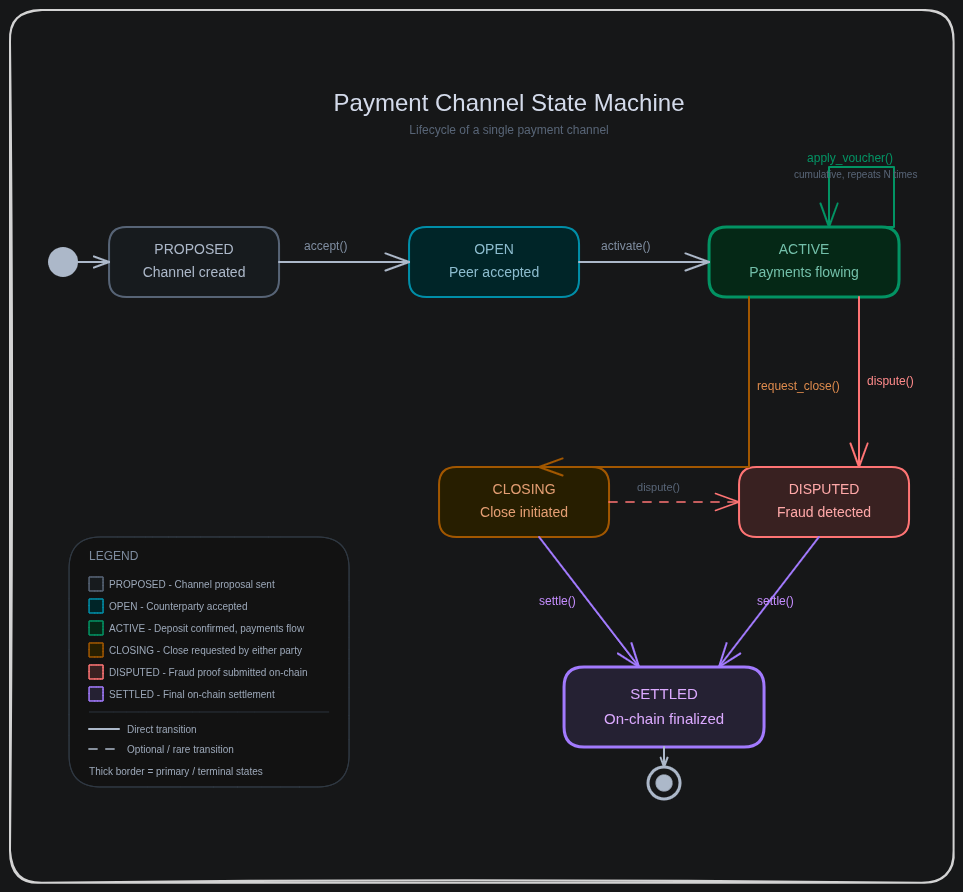 PROPOSED → OPEN → ACTIVE → CLOSING → SETTLED, with DISPUTED branch
Layer 4: Multi-Hop Routing (HTLC)
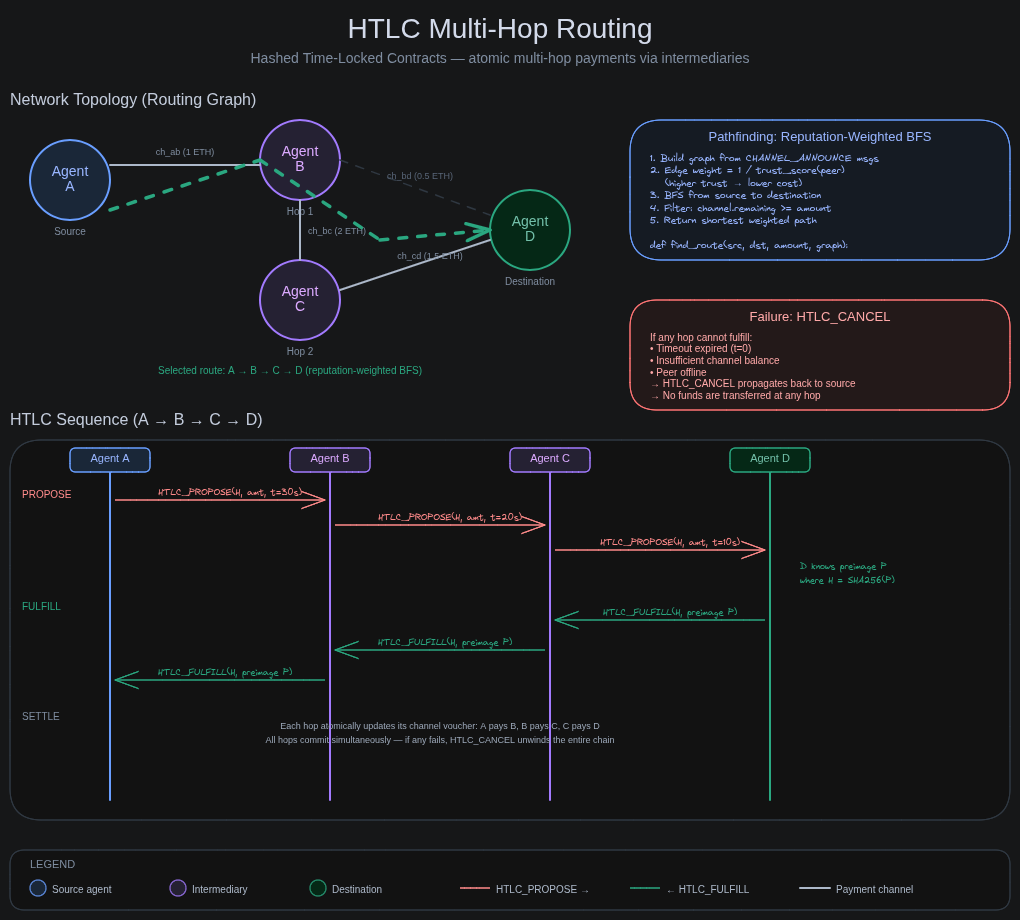 Agent A pays Agent C through Agent B. Each hop has a decrementing timeout.
The pathfinder uses reputation-weighted Dijkstra — highly trusted intermediaries are preferred.
The Trust Layer
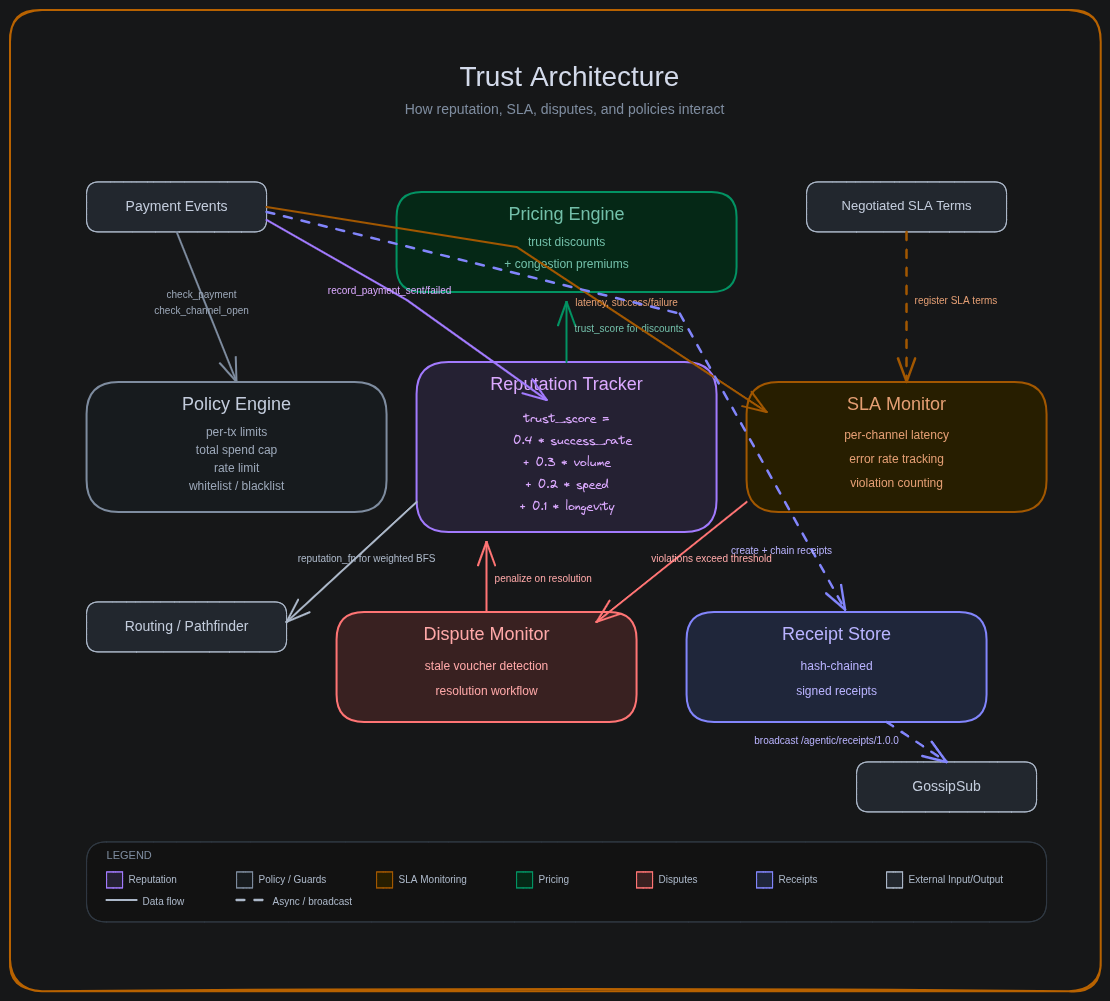 Reputation, SLA, disputes, policies, and pricing tied together.
Reputation: A 4-Factor Trust Score
trust_score = 0.4*success + 0.3*volume + 0.2*speed + 0.1*longevity
Trust scores feed into dynamic pricing and GossipSub peer scoring.
Receipt Chains: A Mini-Blockchain Per Channel
Every payment generates a signed receipt hash-chained to the previous one, broadcast via GossipSub for network-wide verification.
The Agent Runtime
Three strategies: AutonomousNegotiator, CoordinatorBehavior, WorkerBehavior.
When you submit a task:
- Task created →
PENDING - Coordinator finds and assigns to best worker (trust-weighted)
- Worker executes via pluggable executor
- Payment triggered over existing channel
- Trust updated
All autonomous. No human intervention.
Tri-Chain Settlement
| Chain | Contract | Why |
|---|---|---|
| Ethereum | Solidity PaymentChannel.sol |
EVM ecosystem |
| Algorand | ARC-4 app + box storage | Bazaar alignment |
| Filecoin FEVM | Same Solidity contract | Storage market |
Adding a new chain is four methods.
Identity: Two Key Pairs, One Agent
- Ed25519 — libp2p PeerID
- secp256k1 — Ethereum wallet
Bound with EIP-191 and registered on-chain via ERC-8004.
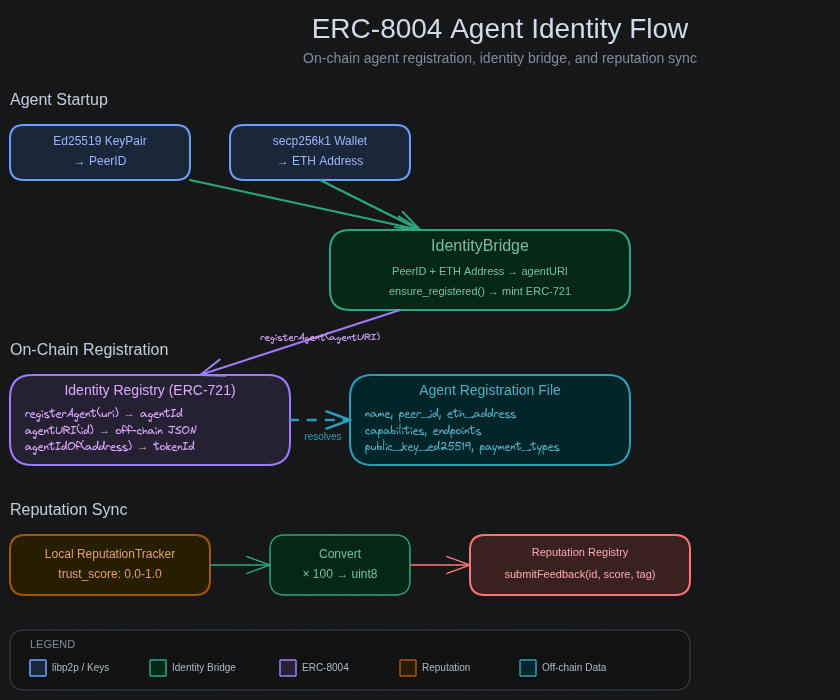 Identity bridge maps PeerID to wallet to on-chain agentId.
By The Numbers
| 680 tests across 40 test files | Protocol, payments, routing, trust, API, integration |
| 55 source modules in 19 packages | Clean separation of concerns |
| ~50 REST API endpoints | Every feature accessible via HTTP |
| 3 settlement chains | Ethereum, Algorand, Filecoin FEVM |
| 13 protocol message types | Complete wire protocol |
| 11 seconds | Full test suite runtime |
What’s Next
- Mainnet settlement — live-chain battle testing
- Encrypted onion routing — production-secure multi-hop
- WebRTC transport — browser-based agents
- Framework adapters — LangChain, CrewAI, AutoGPT
- Cross-chain channels — open on Ethereum, settle on Filecoin
The code is open source. The demo is two commands. Try it.
Built by Yash K. Saini for the PL Genesis hackathon.