How we built AgentPay — a decentralized micropayment protocol that lets AI agents discover, negotiate, pay, and settle with each other, peer-to-peer, with no middleman.
The Agent Economy Is Here. The Payment Layer Isn’t.
Something fundamental is shifting in how software works. AI agents are no longer just answering questions in a chat window — they’re browsing the web, writing code, managing infrastructure, analyzing data, and making decisions autonomously. Projects like AutoGPT, CrewAI, and LangGraph have shown that multi-agent systems can tackle problems that no single model can solve alone.
But here’s the problem nobody talks about enough: how do these agents pay each other?
When Agent A needs Agent B to summarize 10,000 documents, or when a coordinator agent wants to distribute inference tasks across a network of GPU providers, someone needs to get paid. Today, the options are bleak:
- On-chain per transaction: $0.50–$50 per tx, 15-second confirmation times. If your agents are making 1,000 requests per minute, this doesn’t scale.
- Centralized payment APIs (Stripe, PayPal): Require KYC, human approval, API keys, rate limits. Autonomous agents can’t fill out forms.
- Credit/subscription models: Require pre-existing trust relationships. But agents are ephemeral — they spin up, do work, and disappear.
We built AgentPay to solve this. It’s a full economic stack for autonomous agents: discover peers, negotiate terms, lock funds once on-chain, exchange thousands of off-chain micropayments, monitor service quality, resolve disputes, and settle — all peer-to-peer over libp2p.
What We Built (And Why It’s Different)
AgentPay isn’t just a payment channel. It’s the full lifecycle of what agents need to transact economically with each other.
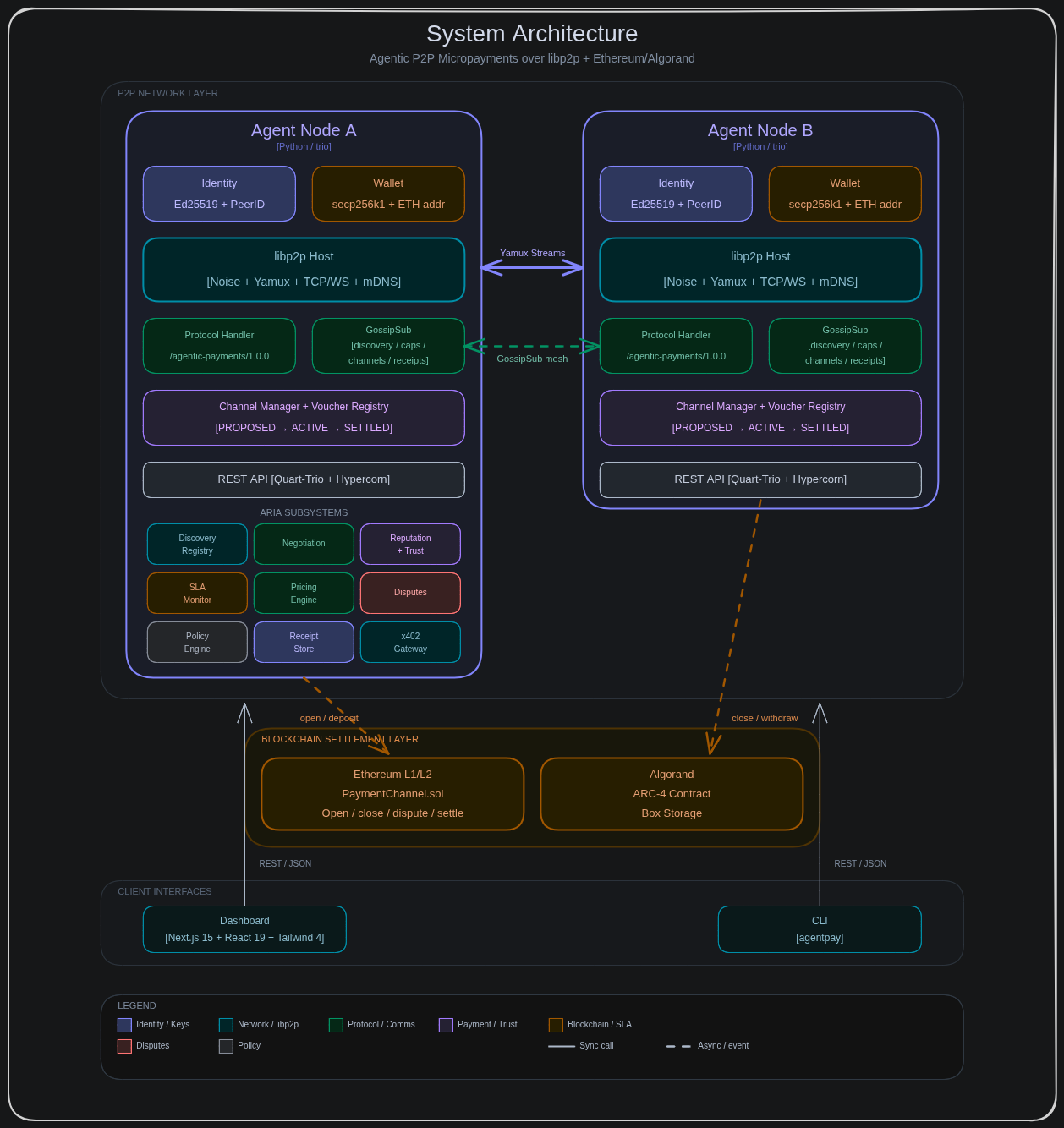 AgentPay system architecture — networking, protocol, payments, settlement, identity, and trust layers
The Seven-Step Agent Payment Lifecycle
Here’s how two agents go from strangers to trading partners:
1. Discovery — Agents find each other via mDNS on a local network or GossipSub pubsub across the internet. Each agent advertises its capabilities (compute, inference, storage, data) in a format compatible with the Bazaar protocol.
2. Negotiation — Before any money changes hands, agents agree on terms. Our 4-message negotiation protocol handles: proposed price, SLA requirements (max latency, max error rate), deposit amount, and service type.
3. Channel Open — The sender locks funds into a payment channel with a single on-chain transaction. This is the only gas-intensive operation.
4. Micropayments — Now the magic happens. The sender signs cumulative vouchers — just like Filecoin’s payment channels — and sends them directly to the receiver over a libp2p stream. No gas. No confirmation wait. Sub-millisecond.
5. Trust Building — Every successful payment updates the receiver’s trust score for the sender, factoring in success rate, payment volume, response latency, and relationship longevity.
6. SLA Monitoring — The channel continuously tracks whether the service provider meets their promised SLA.
7. Settlement — When the channel closes, only the final voucher is submitted on-chain. One transaction settles thousands of payments.
Agent A                          Agent B
   │                                │
   │  1. Discover via mDNS/GossipSub│
   │◄──────────────────────────────►│
   │                                │
   │  2. Negotiate terms + SLA      │
   │◄──────────────────────────────►│
   │                                │
   │  3. Open channel (lock 1 ETH)  │ ← single on-chain tx
   │───────────────────────────────►│
   │                                │
   │  4. Pay 0.001 ETH (voucher #1) │
   │───────────────────────────────►│ ← off-chain, instant
   │  5. Pay 0.002 ETH (voucher #2) │
   │───────────────────────────────►│ ← cumulative, replaces #1
   │  ... ×1000 more vouchers ...   │
   │                                │
   │  6. Close + settle on-chain    │ ← single on-chain tx
   │───────────────────────────────►│
The result: thousands of micropayments with only 2 on-chain transactions total.
The Technical Architecture
AgentPay is structured as six layers, each independently testable and replaceable:
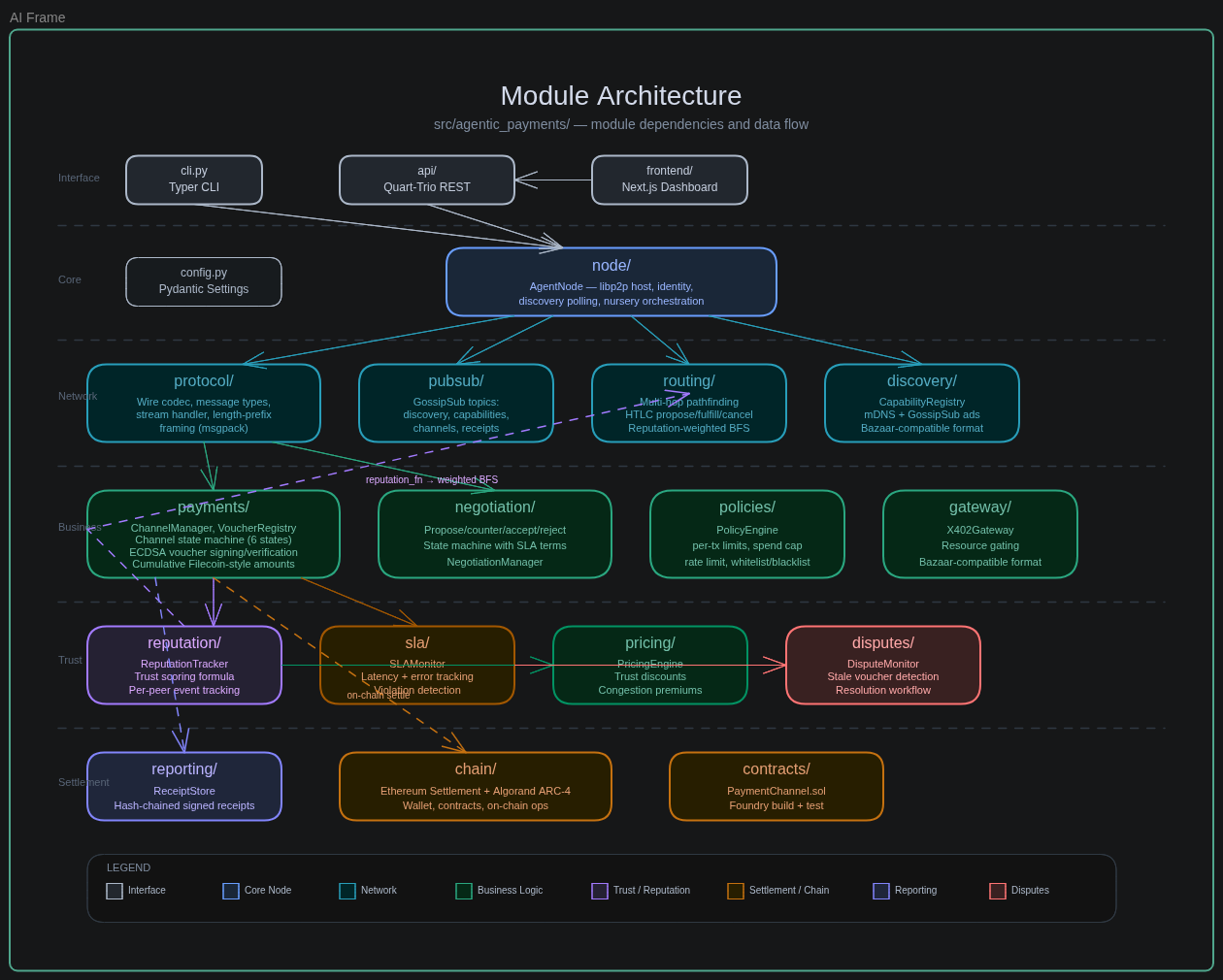 Module dependency map — interface, core, network, business, trust, and settlement layers
Networking: libp2p All The Way Down
We chose py-libp2p over HTTP for a simple reason: agents shouldn’t need servers. With libp2p, every agent is both a client and a server.
Our custom stream protocol (/agentic-payments/1.0.0) uses msgpack with 4-byte length-prefix framing. 13 message types cover the full payment lifecycle.
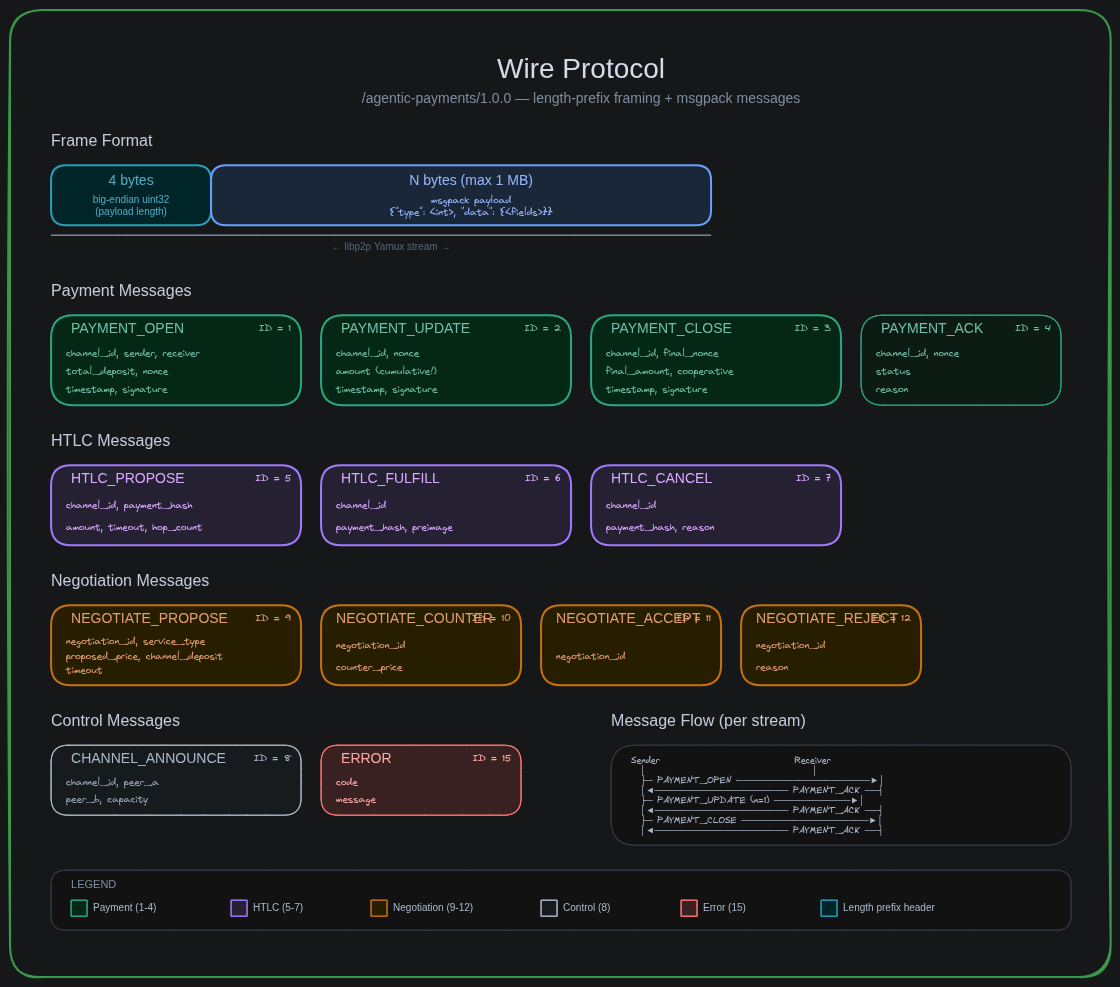 All 13 message types with fields and framing format
Payment Channels: Filecoin’s Model, Adapted for Agents
Each voucher replaces the previous one. If Agent A sends voucher #1 for 0.001 ETH, then voucher #2 for 0.003 ETH, only voucher #2 matters.
The channel state machine has 6 states with a challenge period for dispute resolution:
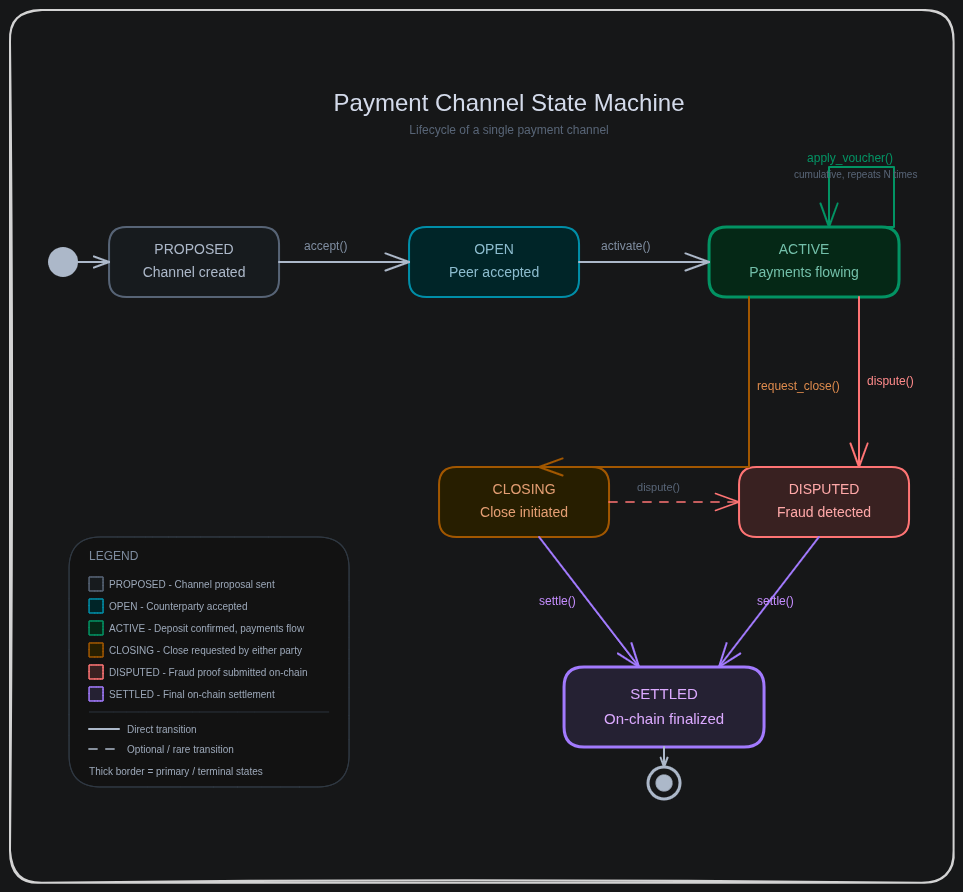 6-state lifecycle: PROPOSED → OPEN → ACTIVE → CLOSING → SETTLED, with DISPUTED branch
Multi-Hop Routing: HTLC Like Lightning
AgentPay supports Hash Time-Locked Contract (HTLC) multi-hop routing — the same primitive that powers Bitcoin’s Lightning Network.
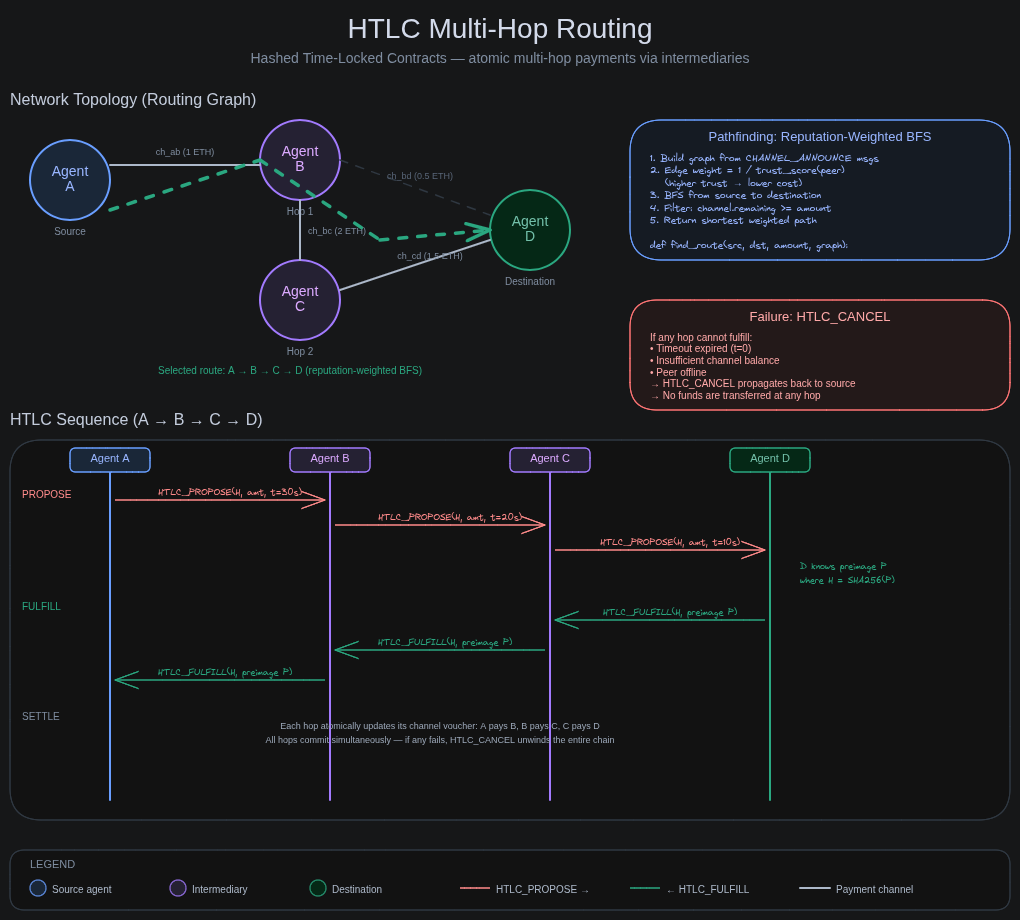 Multi-hop payment via intermediaries with reputation-weighted BFS pathfinding
Tri-Chain Settlement
| Chain | Contract | Use Case |
|---|---|---|
| Ethereum | Solidity PaymentChannel.sol |
EVM ecosystem, DeFi composability |
| Algorand | ARC-4 + box storage | Bazaar/x402 ecosystem interop |
| Filecoin FEVM | Same Solidity contract | Storage market alignment |
Identity: ERC-8004 + EIP-191
Every agent has two key pairs: Ed25519 for libp2p peer identity and secp256k1 for Ethereum payments. We bridge these with EIP-191 and implement ERC-8004 for on-chain identity.
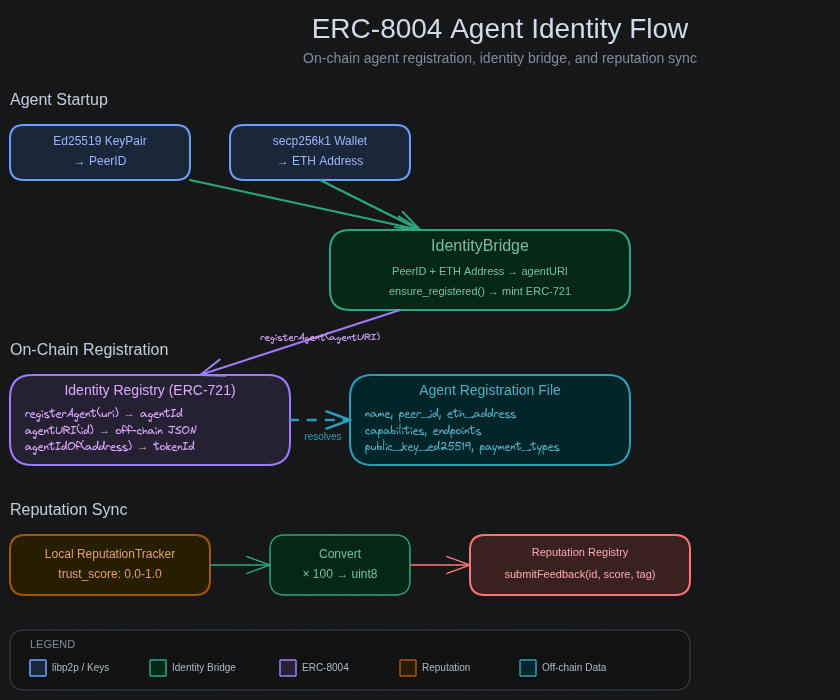 Agent registration, identity bridge, reputation sync
The Trust Layer: Why Payments Alone Aren’t Enough
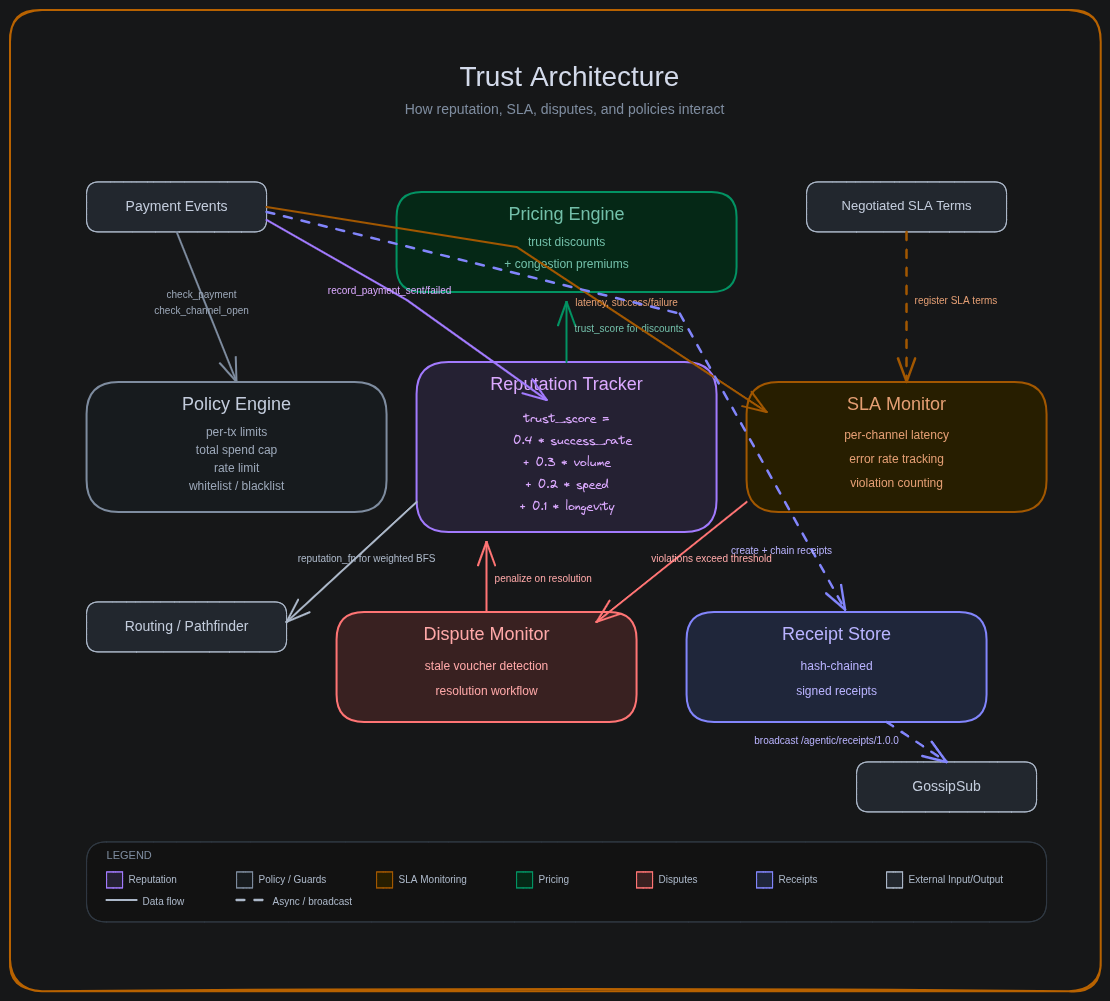 Reputation, SLA monitoring, disputes, policies, and pricing interactions
Reputation Scoring
trust_score = w1 * success_rate + w2 * volume_score + w3 * latency_score + w4 * longevity_score
Dynamic Pricing
final_price = base_price * (1 - trust_discount) * (1 + congestion_premium)
The Agent Runtime: The Differentiator
The runtime is a tick-based system with three built-in strategies: AutonomousNegotiator, CoordinatorBehavior, and WorkerBehavior. Submit a task, and the runtime autonomously negotiates, assigns, executes, and settles.
The Numbers
| Metric | Count |
|---|---|
| Tests passing | 680 |
| Source modules | 55 across 19 packages |
| REST API endpoints | ~50 |
| CLI commands | ~50 |
| Settlement chains | 3 |
| Protocol message types | 13 |
Running the Demo
# Terminal 1: Start 2 agents + dashboard
./scripts/dev.sh

# Terminal 2: Run the 10-phase live demo
./scripts/agent_demo.sh
Links
- GitHub: github.com/yashksaini-coder/AgentPay
- Architecture: docs/ARCHITECTURE.md
- CLI & API Reference: docs/COMMANDS.md
Built by Yash K. Saini for the PL Genesis hackathon. 680 tests. 55 modules. 3 chains. Zero middlemen.